Artificial intelligence is the most powerful general-purpose technology humanity has ever created. It reads code, interprets complex imagery, and reasons about systems. It generates solutions at a scale no human team can match. AI is an engine of cognitive acceleration. It processes vast oceans of domain knowledge, identifies hidden patterns in molecular structures, and automates physical labor. Ultimately, it can build entirely new industries, scientific tools, and engineering fields.
Had this technology emerged in an era driven by audacious human vision, it would be deployed to eradicate chronic disease, rebuild crumbling global infrastructure, democratize elite education, and propel human productivity into an exponential curve. Instead, short-sighted corporate stewards and venture-backed billionaires dominate AI today. Their grandest ambition for humanity’s ultimate breakthrough is shockingly mundane. They want to reduce headcount, trim operational expenses, and build a cost-reduced version of the present.
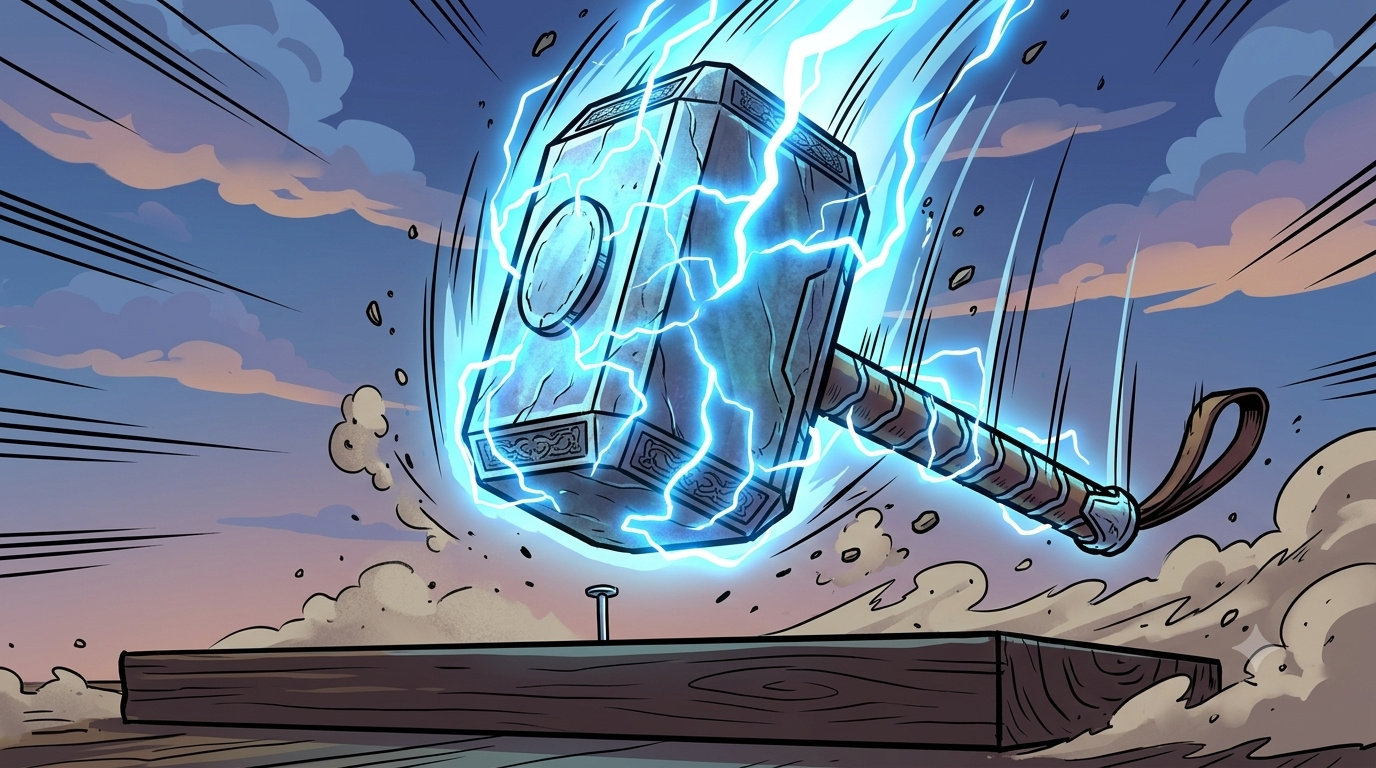
We hold Thor’s hammer—a tool capable of moving mountains and building empires. Yet, our tech leadership uses it as a simple claw hammer to drive nails faster.
The Shrinking Vision of Silicon Valley
Top AI leaders offer a surprisingly small vision. Executive narratives rarely focus on the new frontiers humanity can conquer together. Instead, they focus heavily on “efficiency gains,” “task automation,” and “headcount reduction.”
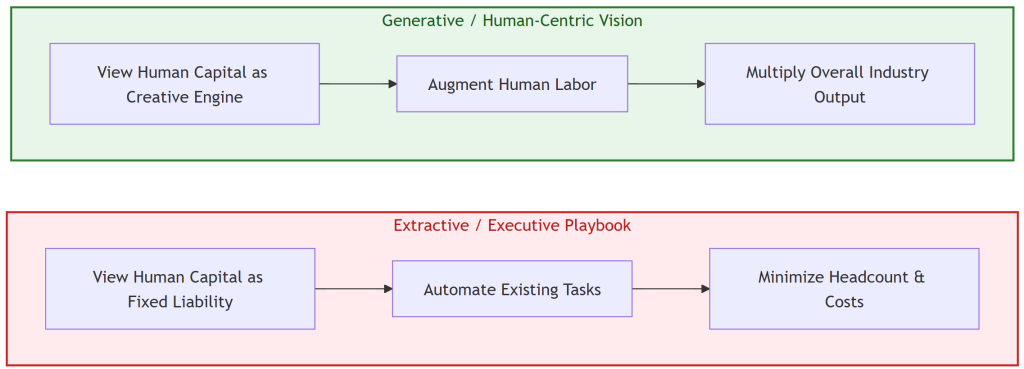
Tech leaders do not ask how AI can help a worker accomplish tenfold more work. Instead, they calculate how many workers they can eliminate today. Their own public quotes reveal a clear mindset of subtraction:
Sam Altman (CEO, OpenAI): Warned in an interview with The Atlantic that AI “will eliminate a lot of current jobs.” He called this reduction an unavoidable economic shift. In customer support, he told Fortune: “Now you call one of these things and AI answers… It’s like a super-smart, capable person… It does not make mistakes. It’s very quick. You call once, the thing just happens, it’s done.”
- Satya Nadella (CEO, Microsoft): Stated in an announcement covered by CNBC that AI will “reshape every software category.” However, he anchored that transformation in “efficiency gains” and leaner teams.
- Sundar Pichai (CEO, Alphabet): Framed the impact of AI in a 60 Minutes interview with CBS News as something that “will impact every product across every company.” He focused heavily on the “automation of tasks people do today.”
- Jensen Huang (CEO, NVIDIA): Declared during a keynote covered by Reuters that “software will write software.” He implied that large portions of human software engineering work will simply disappear.
- Mark Zuckerberg (CEO, Meta): Outlined Meta’s operational priorities in internal calls reported by Bloomberg. He aims to “automate more of what people do” to cut management layers.
- Arvind Krishna (CEO, IBM): Stated directly to Bloomberg that AI will replace back-office roles. He paused hiring for thousands of administrative jobs that AI can take over.
- Elon Musk (CEO, Tesla/xAI): Predicted at the UK AI Safety Summit, reported by BBC News, that AI will eventually “make jobs kind of pointless.” He envisions a future where traditional human labor is unnecessary.
These are not statements of ambition. They are statements of reduction.
They imagine a future that is cheap rather than capable. This reveals a failure of imagination and leadership. Meanwhile, the real world faces massive structural labor shortages.
Case 1: Healthcare — Data-Driven Liberation from Clinical Burnout
The Hard Numbers & Market Crisis
Global healthcare systems suffer from severe labor shortages and heavy administrative drag:
- Global Labor Deficit: The World Health Organization (WHO) projects a global shortfall of 11 million healthcare workers by 2030. The Association of American Medical Colleges (AAMC) forecasts a U.S. shortage of up to 139,000 physicians within the decade.
- Catastrophic Attrition: Data from the U.S. Health Resources and Services Administration (HRSA) shows alarming burnout. Over 41% of registered nurses and 30% of overall healthcare personnel plan to leave their roles.
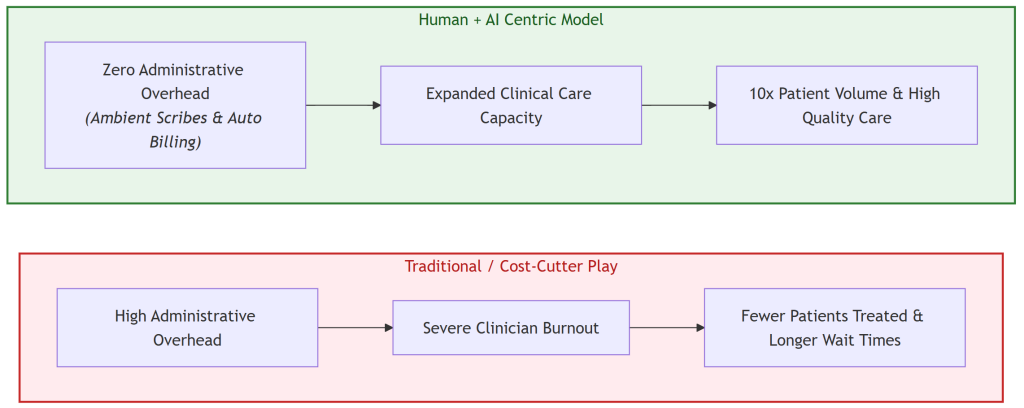
- The Administrative Burden: Physicians spend roughly half of their daily working hours entering data into Electronic Health Records (EHR). They spend valuable time handling insurance authorizations and medical billing instead of treating patients.
The Misguided “Efficiency” Play
Tech executives view healthcare through a cost-reduction lens. They try to replace triage nurses with conversational chatbots. They automate diagnostic approvals to deny insurance claims faster. They push patients toward automated digital interfaces to eliminate clinical salaries.
The Human-Centric AI Vision
We can transform healthcare by deploying AI to empower clinical teams rather than eliminate them:
- Administrative Liberation: AI speech-to-text models and ambient scribes handle chart documentation, billing codes, and insurance pre-authorizations in real time. This gives doctors and nurses back 3 to 4 hours per day for direct patient care.
- Diagnostic Augmentation: Deep learning models pre-screen MRIs, CT scans, and pathology slides instantly. They highlight subtle anomalies for physician review. The human doctor remains the final decision-maker but operates with far higher speed and precision.
- Scaling Human Capacity: Removing administrative drag allows health providers to onboard, train, and employ more nurse practitioners and community care workers. This expands patient access across all communities.
Pairing AI with an expanded human medical workforce transforms healthcare. It turns medical treatment from a scarce luxury into an abundant, high-quality public utility.
Case 2: Infrastructure — Rebuilding the Physical World
The Hard Numbers & Market Crisis
Physical infrastructure is deteriorating faster than human crews can repair it. Capital deficits and severe labor shortages choke modern progress:
- The $3.7 Trillion Deficit: The American Society of Civil Engineers (ASCE) reports a $3.7 trillion infrastructure funding and execution gap in the U.S. over the next decade. Bridge rehabilitation needs alone exceed $191 billion.
- Skilled Labor Shortages: Heavy infrastructure sectors face record job vacancies. Seasoned tradespeople are retiring much faster than new apprentices enter the industry.
AI Bots Assisting Tradespeople
Consider one of civil engineering’s most dangerous tasks: building deep-water bridge foundations and subsea piers.
Setting subsea footings and pouring concrete caissons 200 feet underwater currently requires commercial saturation divers. These divers work in dark, freezing, high-current environments. Commercial diving carries fatal accident rates over 40 times higher than the average workforce. Divers face severe risks of decompression sickness, nitrogen narcosis, equipment failure, and crushing water pressure. Because humans can only stay at those depths for short periods, deep bridge construction takes years.
We must replace human risk with intelligent automation while keeping human oversight:
- The Corporate Misstep: Executives use simple subsea probes to trim inspection budgets. Meanwhile, the broader infrastructure backlog continues to grow.
- The Human + Bot Model: A human structural engineer sits safely in a surface command center. The engineer designs precision 3D CAD models, sets site parameters, and issues digital work orders.
- Autonomous Execution: A fleet of autonomous underwater “auto-bots” works subsea. Equipped with multibeam sonar, acoustic telemetry, and robotic arms, they clear subsea bed silt. They perform high-yield plasma welding, construct steel cages, and pour underwater concrete with sub-millimeter precision.
Removing humans from dangerous underwater work accelerates project timelines. Work that once took five years of life-threatening labor finishes in six months. Tradespeople become robotic controllers, site directors, and master engineers. Their skills and knowledge could be implemented in ensuring that the bots are building it right. Society gains the capacity to build high-speed rail, offshore wind foundations, and resilient bridges at an unprecedented scale.
The Opportunities Are Endless
Bound Only by Vision and Courage
Healthcare and infrastructure are just two drops in an ocean of possibility. The true limits of artificial intelligence are bound only by our imagination and our dare to dream. Every domain of human endeavor can experience an exponential leap forward when we combine machine intelligence with human ambition.
- Education & Mentorship: Imagine every child on Earth having a personalized, 24/7 AI tutor that adapts instantly to their unique learning speed, curiosity, and language. Instead of replacing teachers, AI empowers educators to mentor class sizes with individual precision.
- Scientific Discovery & Agriculture: AI can simulate millions of molecular compounds in days to discover clean energy materials, novel antibiotics, and drought-resistant crops. Human scientists can design farming systems that eliminate global hunger without depleting natural ecosystems.
- Software & Creative Engineering: Developers can stop spending weeks fixing boiler-plate syntax and legacy technical debt. Instead, engineers can focus entirely on system architecture, creative product design, and solving complex real-world logic.
Redefining What “Better” Means
We must remember at every turn that a “better” society is not measured by higher stock prices or corporate margins. True progress means expanding human agency, ending systemic scarcity, and improving the quality of life for all people.
AI gives us the capability to advance by leap years rather than incremental percentage points. But technology alone does not guarantee a brighter future—our priorities do. We must demand a world where technological acceleration serves the elevation of the human race, not just the balance sheets of a select few.
And we must remember at the verge of every corner that better doesn’t mean more money but the ability of us as a race to do better.
Reclaiming Humanity: Growth for All, Not Scraps from Billionaires
Refusing Economic Reductionism
Our challenge is moral rather than technical.
Current AI leaders act like bean counters rather than humanists. They treat human labor as an expense to eliminate from a balance sheet. They ignore a fundamental truth: human dignity and flourishing are the ultimate goals of economic activity.
Money, corporate equity, and quarterly profit margins are arbitrary accounting metrics. They are not the end goal of civilization. Silicon Valley’s current path pushes us toward a dystopian oligarchy. In this system, a tiny caste of tech leaders hoards automated productivity, while 99% of humanity relies on corporate “scraps.”
AI as the Exoskeleton for Human Capability
We must reject economic reductionism. Growth must benefit all of humanity, not just those who own server farms.
Artificial intelligence is our final frontier. It can eliminate physical toil, collapse scarcity, and democratize expert knowledge. AI can elevate every person into a builder, creator, and problem-solver. However, AI will only deliver this promise if we demand that it serves as an exoskeleton for human capability rather than a replacement for human worth.
Humanity can advance at incredible speed. We hold Thor’s hammer in our hands. We must take control and use AI to build a world of shared abundance, radical equality, and boundless human potential.